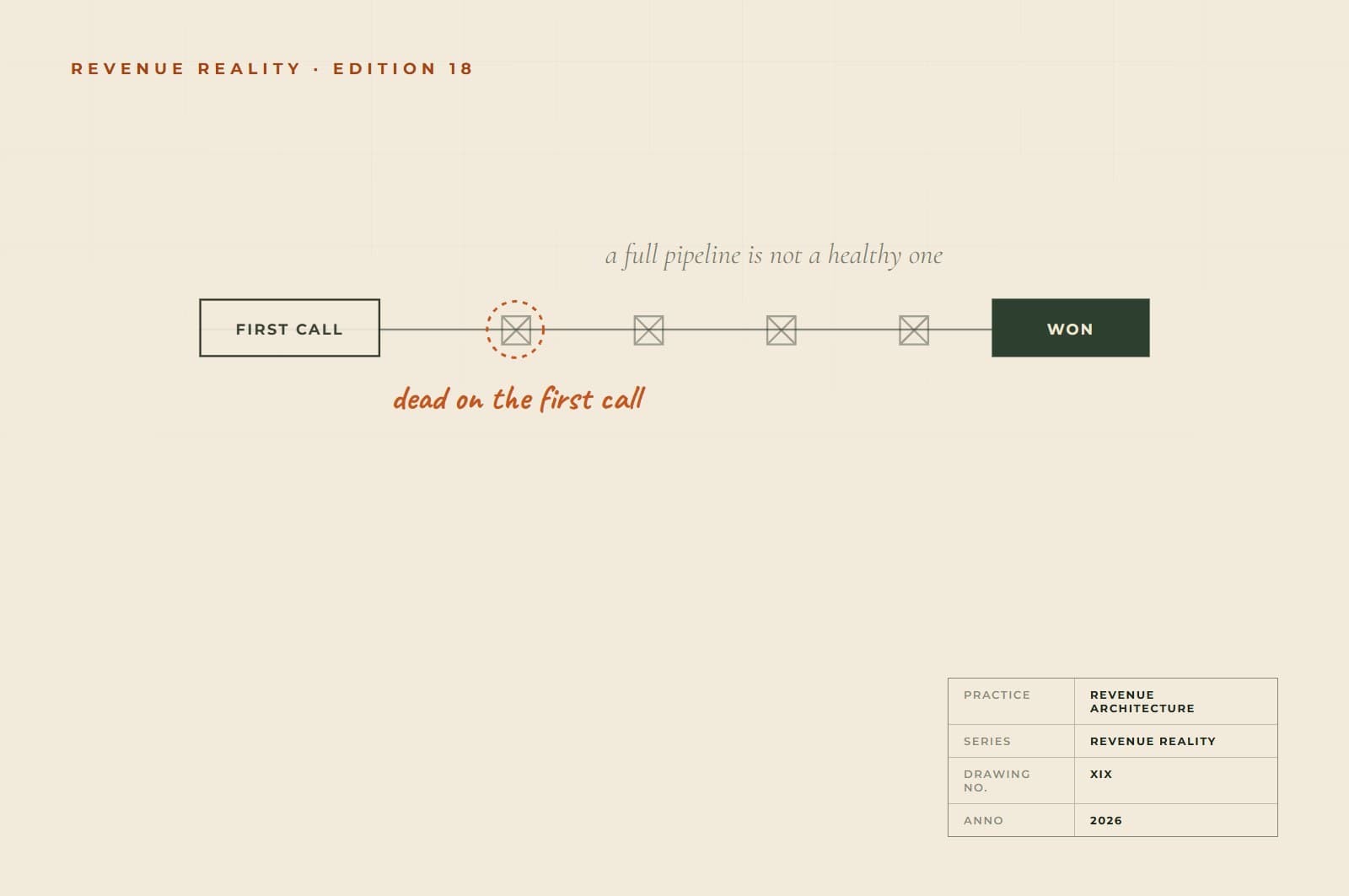
A full pipeline feels like safety, and it lies. A large share of the deals your best reps are working were decided against on the very first call, and the team keeps nursing them for months because they behave like real deals. The cost is not those deals. It is the calendar they steal from the ones that would actually close. Here is why a deal can pass every qualification checklist and still be dead on arrival, the three questions that catch it on the first call, and what disqualifying early gives you back.
 From the archive
Every founder trusts a full pipeline. It feels like safety. Numbers going up, deals in every stage, reps busy from Monday to Friday. So it is unsettling to sit down and audit one, deal by deal, and watch half of it turn out to be already dead. Not slow. Not in need of another touch. Dead, in the sense that the buyer was never going to purchase and said so, in their own way, on the very first call. Your best rep is still working them three months later, because a dead-fit deal is a good actor. It replies to email. It sits through the demo and says it looks great. It asks you to send a proposal. It does everything a real buyer does except the one thing that matters, and then at ninety days it goes quiet and gets filed under lost to no decision, as if it were ever going to be anything else. You do not have a closing problem on these deals. You have deals that were dead on arrival, dressed up as pipeline, billing you a rep’s calendar.
The two are different things, and the difference is invisible on the dashboard. Two reps can carry the same dollar value of open deals. One is carrying real buyers with a real problem. The other is carrying curiosity, politeness, and people who took the call because their afternoon was open. The dashboard shows both as pipeline. Only one of them becomes revenue, and you cannot tell which by looking at the total.
This is why the close rate is the wrong number to work on first. When your win rate is low, the instinct is to coach the close and buy more leads. But the close rate is a fraction, and the denominator is stuffed with deals that were never yours to win. You are dividing your real wins by a pile of conversations and reading the result as a sales-skill problem. Fix the denominator and the same reps, closing the same way, post a number that finally reflects what they can actually do.
The padding does not announce itself, which is what makes it expensive. A dead-fit deal behaves exactly like a live one right up until the moment it quietly disappears, so it survives every pipeline review. Nobody flags it, because on paper it is doing all the right things. It takes a deliberate audit, against the right questions, to see that it was decided months ago.
Consider two reps on the same team, selling the same product to the same lead source on the same pay plan. Call them Wes and Elena.
Wes carries twenty-two open deals and is proud of it, because it is the biggest pipeline on the board. He never says no to a deal. Someone shows interest, he books the demo. Someone asks for a proposal, he builds it. His forecast is enormous, and his quarter comes in at five closed deals. Elena carries thirteen. Her manager keeps asking why her pipeline is so thin. On the first call she asks two or three questions most reps skip, and when the honest answers come back wrong she closes the loop politely and moves on. She disqualifies people Wes would have chased for a month. Her quarter comes in at six.
Same leads. Elena closes more in absolute terms while carrying nine fewer deals, because every hour she has goes to a deal that can actually move. Wes closes less while looking busier, because his week is spread across twenty-two deals and half of them were never going to close. When we audited his twenty-two, twelve had no trigger event and no cost of doing nothing. Nothing in the buyer’s world had changed to make this a problem now, and nothing bad happened to them if they did nothing. On the recordings, that was audible on the first call. Wes heard “this is interesting, send me something” and logged a deal. Elena heard the same words and logged a no.
The difference between them is not talent, and it is not effort. Wes works harder than almost anyone. It is that Elena knows how to hear a dead deal on the first call and has the discipline to act on what she hears, and Wes was never taught either one.
Three questions. Run them on the first call, and run them today on every open deal in your pipeline. Two “no” answers and it was never a deal.
A real deal starts with a trigger: new leadership, a missed number, a failed launch, a competitor move, something that turned a background annoyance into a problem worth money and attention now. If nothing changed, there is no urgency, and no urgency means no deal. "Just looking" is not a trigger. It is a rep talking himself into a forecast.
This is the cost of inaction, and it is the single most predictive question in the deal. If the honest answer is "nothing much," you do not have a deal, you have a pleasant conversation. You are not competing against another vendor. You are competing against their inaction, and their inaction is free, patient, and undefeated.
Every buyer has ten problems and the budget and attention to fix three. A real problem they rank fourth loses every quarter to the three above it. You will not lose that deal to a competitor. You will lose it to "we decided to focus on other priorities," which is what a top-ten problem sounds like when it finally speaks.
The cost of chasing dead-fit deals is not the deals themselves. Those were always going to end in nothing. The cost is the time they steal from the deals that were going to close, and that cost has a number.
Take an illustrative profile: a $5M company with four reps who sell like Wes, each fully loaded at $130,000, so $520,000 a year in selling capacity. Audit the open pipeline the way we audited Wes and say roughly 45% of the open deals carry two or more dead-fit tells, and those deals eat about 40% of the team’s selling time. Dead-fit deals are needy. They ask for another call, another stakeholder, another revised proposal, precisely because there is no real decision underneath to move them forward, so they generate motion instead of progress.
Forty percent of $520,000 is $208,000 a year of selling capacity poured into deals that were decided against on the first call. And that is the smaller cost. The bigger one has no line item: the real deals, the ones that were going to close, worked at half attention because the rep was busy tending zombies. Thirteen real deals worked properly will out-close twenty-two deals where half were never going to move. Wes is not lazy. He is busy on the wrong deals, and busy on the wrong deals looks exactly like working hard right up until the forecast misses.
Most qualification frameworks answer the wrong question. They ask whether the buyer can purchase: budget, authority, need, timeline. Can they pay, do they decide, do they want it, and when. Those are real questions, and they miss the deals that are killing you, because a deal can pass every one of them and still be dead on arrival. The budget exists. The buyer has authority. There is a nominal need, the kind everyone has. The timeline is "this quarter." And it still never closes, because nothing actually breaks if they walk away. It clears the checklist and dies anyway, and you never see it coming because the checklist said go.
Fit asks a different question. Not "can they buy," but "should you even be in this deal." Is there a real problem, is it a problem now, and does this buyer rank it high enough to act. Those three answers decide whether a deal is alive long before budget or authority ever matter. This is why your reps qualify and still drown. They are running a can-they-buy checklist on people who can absolutely buy and are absolutely never going to. The gap is not that Wes forgot to ask about budget. The gap is that nobody taught him to ask whether there was a deal there at all.
Pull your best rep’s ten oldest open deals, the ones that have been active longest without closing. The oldest deals are the ones most likely to be dead-fit and best at hiding it. For each one, answer the three questions honestly, from the actual call notes, not from hope. What changed for this buyer? What breaks if they do nothing? Is this in their top three? Where you cannot answer from the record, that is its own answer.
Any deal with two or more nos comes off the board this week. Not "nurture." Off. Then watch what happens to your rep’s other deals when she gets those hours back. Disqualifying is not losing. You cannot lose a deal that was never alive. You can only stop paying to keep it warm, and the moment you stop, the time you were spending on ghosts goes back to the deals that were always going to decide your quarter.

Twelve years across three continents rebuilding the infrastructure B2B companies use to turn good people into predictable revenue. Now working from Sweden, with a smaller calendar and a tighter focus. Thanks for reading, new essays land here most weeks.
One essay a week on the work underneath B2B revenue. No pitch.
A 45-minute call. I tell you where the leaks are, whether or not we work together.
Let's talk