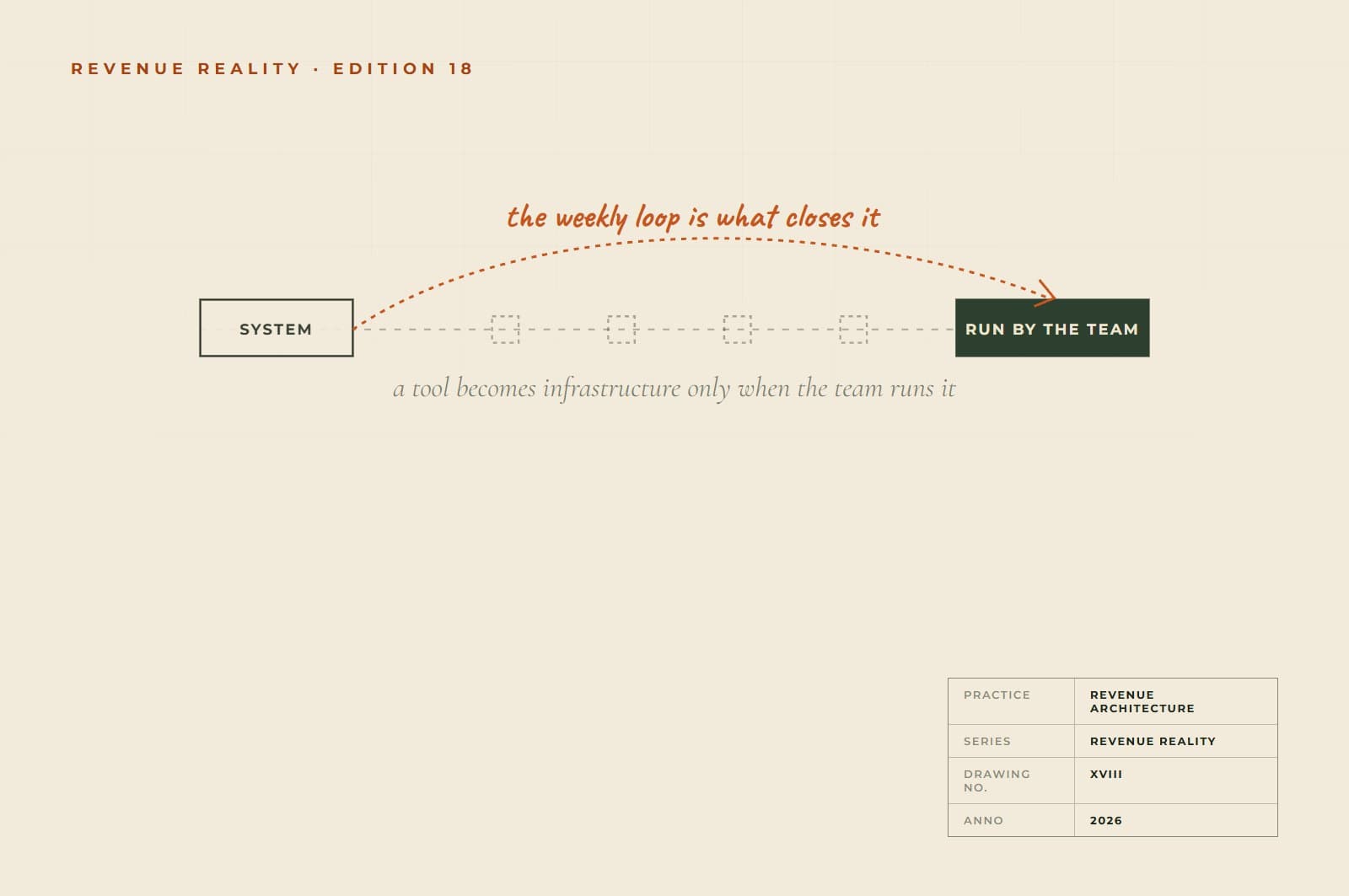
You built the follow-up system, and six weeks later the usage data says nobody is using it. The reflex is to blame the tool and start shopping for a better interface. The tool is fine. Adoption is not an install, it is a leadership job, and the thing that closes the gap is a weekly loop, not a training video. Here is why a system nobody runs is shelfware, what it actually costs, and the four-move loop that turns a tool into the way the team works.
 From the archive
Every company is paying for software nobody opens. You can find it in any budget: the analytics suite three people learned, the project tool that lost to a group chat, the CRM add-on someone championed in the spring and quietly abandoned by the autumn. Sales is where it hurts most, because the tools get bought at the top and run at the bottom, and the two rarely meet. So here is a scene you may know. You spent real money building the follow-up system from last edition, the documented cadence, the sequence that runs itself, the signal layer that flags a deal going quiet before it is gone. It works. You watched it work. Then you opened the usage data six weeks later and found the truth: the sequence fires and the tasks pile up, dismissed. One or two reps run it the way you designed. Everyone else slid back to following up on memory and mood, exactly like before, except now there is a dashboard nobody opens sitting on top of the old behavior. You did not buy the wrong tool. You skipped the only thing that ever makes a tool get used.
The instinct at this point is to blame the software. Wrong tool, bad setup, clumsy interface. So you open a support ticket, book a call with the vendor, and start pricing something that demos better. You are about to spend the next quarter solving a problem you do not have. The tool is fine. Your team is not using it, and no software has ever fixed that, because using it is a behavior, and behavior is not a feature you can buy.
A tool no one runs is not infrastructure. It is shelfware with a login, and it bills you the full price of the build while quietly handing back a fraction of the return. The reason it drifts has nothing to do with the interface. Reps do what gets inspected, coached, and repeated. If nobody watches whether the sequence runs, running it becomes optional, and optional, under pressure, means no.
Follow-up is the first thing to feel optional, because of how reps are paid. They are measured on closed revenue, not on process, so any step that does not obviously move a deal today is the first to go on a week that is already full. Running the sequence on a deal that went quiet feels like admin. Chasing the deal that is talking back feels like selling. Under quota pressure, a rep does what feels like selling and skips what feels like admin, and the system you built lands squarely in the admin pile, right next to every other tool the company bought and forgot.
At one company I watched the identical follow-up system go out to two teams of five in the same week, with the same training, run by two different managers. Call them Marcus and Priya. Six weeks later the two teams were living in different worlds, and the tool was not the variable.
Marcus ran the rollout the way most rollouts go. He recorded a walkthrough, posted it in Slack, told the team the new sequence was live, and asked everyone to make it a habit. Then he went back to his pipeline reviews, which are about deals, not behavior. Adoption on his team settled around 25%. Two reps used it. The rest dismissed the tasks and followed up the old way, and when a deal died nobody could say whether the system had even fired.
Priya treated it as a behavior, not an announcement. Every week she pulled a single number: how many stalled deals actually got the sequence run on them. Every week she took one real deal where a rep had ignored it and sat down for ten minutes. One week it was a $30K deal a rep had let sit for eight days after the proposal. The signal had fired on day three, and he had dismissed it. She did not lecture him about using the tool. She showed him the eight days, put a number on what a stalled week costs at his close rate, and handed him the exact next touch to send that afternoon. One deal, one moment, one fix, reviewed the following week. Inside six weeks her team was past 80% adoption, and the abandoned-deal line the system was built to recover was actually coming back.
Same tool, same training video, same week. Talent had nothing to do with it, and neither did the reps. Priya coached the behavior on a schedule. Marcus announced it and hoped. That difference has a price, and it is not small.
Adoption is not a soft metric you track for a slide. It is a direct multiplier on every dollar the system was supposed to recover, and the number is worse than it looks because it comes back every year. Take the mid-market profile from the last two editions: a $4.5M company bleeding roughly $300,000 a year in post-demo deals that go dark and never get a systematic touch. That $300,000 is what the follow-up system was built to recover, and the build plus the first year of tooling ran, say, $60,000. That cost is fixed. It is the same whether the team uses the system or not.
At Marcus’s 25% adoption, the system reaches a quarter of those stalled deals and pulls back about $75,000. At Priya’s 80%, the same system at the same cost pulls back about $240,000. The difference is $165,000 a year, and not one dollar of it is a software feature. It is whether someone led the behavior or filmed a video about it. And it recurs. That gap is not a one-time write-off. It comes back every year the adoption stays broken, on top of the forecast you are still building off a system only a quarter of the team actually runs.
Here is the trap founders fall into after they build the system. They treat adoption as an information problem. If the team just understood the tool, they would use it. So they explain it again, better, with a longer video and a cleaner deck. It never works, because adoption was never an information problem. Your reps understood the sequence after the first walkthrough. Understanding is not the barrier.
The barrier is changing what a person does under pressure, when the old habit is faster and the new one is being ignored by half the team anyway. You do not move that with a broadcast. An announcement is a one-time event. Behavior is a standing pattern, and you cannot shift a standing pattern with an event, no matter how well produced. The manager who rolls out a system with a video is bringing a memo to a habit fight.
This is the same reason a CRM upgrade never fixed follow-up and a training day never fixed close rates. The tool changed. The loop that governs behavior did not. Nothing that gets coached once, on a Tuesday, in a video, survives contact with a busy Thursday. What changes behavior is not a bigger broadcast. It is a smaller, relentless loop. The full five-step version of that loop is a framework I call the Call Autopsy, and I broke down all five steps in a separate piece.
Four moves, run every week, per rep. This is the Call Autopsy pointed at a rollout: it turns a tool nobody runs into the way the team works.
Pull the one number that shows whether the system is being used, not whether deals closed. How many stalled deals got the sequence run on them this week? That is your real adoption rate, and until you look at it every week, it is a guess.
Take one real deal where the system was ignored. Find the exact point the sequence should have fired and did not. Not "use the tool more." The specific deal, the specific moment, and what the silence cost, in dollars. One delta, quantified.
Not "run the sequence." The precise action, on the next deal that stalls, this week. Behavior changes one rep and one behavior at a time. Stack ten fixes on a rep and none of them land.
Coached this week, checked next week, same time, every time. The moment following up on the coaching becomes optional, the reps correctly conclude the system was optional too. The schedule is the whole point.
Because the loop is unglamorous and the video feels like progress. Pulling one adoption number and coaching one deal every week, per rep, is slow, repetitive, and invisible to everyone above you until the pipeline moves. Filming a polished walkthrough and announcing a launch feels like leadership. So the average manager does the announcement, goes back to deal reviews, and lands exactly where Marcus did, with a system on the books and the old behavior underneath it.
The managers who close the gap do the boring thing on a schedule. They make adoption a number they inspect, they coach one moment a week per rep, and they never skip the review. That is not a personality trait. It is infrastructure, the same as the sequence itself. You built the system so the follow-up would stop depending on whether a rep felt like it. The adoption loop is the same idea aimed one level up: it makes running the system stop depending on whether a rep feels like it either.
Open your follow-up system and pull one number: what percentage of your stalled deals actually got the sequence run on them last week. Not opened. Run. That is your real adoption rate, and if you have never looked at it, brace yourself. The number is almost always lower than the manager guesses, and the gap between what you assume and what is happening is exactly the revenue leaking back out.
Then pick one rep and one deal where the system was ignored. Sit down for ten minutes. Find the exact moment the follow-up should have fired, name what the silence cost, and give them the precise next action on their next stalled deal. Put the review on the calendar for the same time next week, and keep it. Do that every week, one rep and one deal, and watch adoption climb. Skip it, and the system you paid to build keeps billing you full price while handing back a quarter of the return. You did not have a tooling problem. You had a coaching vacuum. That you can fix, and no vendor can.

Twelve years across three continents rebuilding the infrastructure B2B companies use to turn good people into predictable revenue. Now working from Sweden, with a smaller calendar and a tighter focus. Thanks for reading, new essays land here most weeks.
One essay a week on the work underneath B2B revenue. No pitch.
A 45-minute call. I tell you where the leaks are, whether or not we work together.
Let's talk