You bought the platform with AI on the pricing page, turned on the sequences, and three months later the same deals are dying in the same silence, except now there is a monthly invoice attached. The tool was never the fix. A CRM is a system of record; follow-up is a system of action. Here is the two-layer build that actually closes the gap, why the order is not optional, and the honest math on what the second layer is worth.
 From the archive
A CRM is a filing cabinet that learned to send email. That is not an insult to your CRM. It is the most useful thing you can understand about it, because the moment you see it clearly, you stop expecting it to do a job it was never built for. You bought the platform with “AI” on the pricing page. You configured the sequences. You watched the demo where the founder of the software clicks three buttons and a dead deal revives itself. Three months later you open your pipeline and the same deals are dying in the same silence, except now you are paying a monthly invoice to watch it happen. Last edition was about the leak underneath this, the deals that get abandoned rather than lost. I ended it with a promise: your CRM will not fix that, and I would show you what does. So here it is, and the first thing to say is the uncomfortable one. The tool was never the fix.
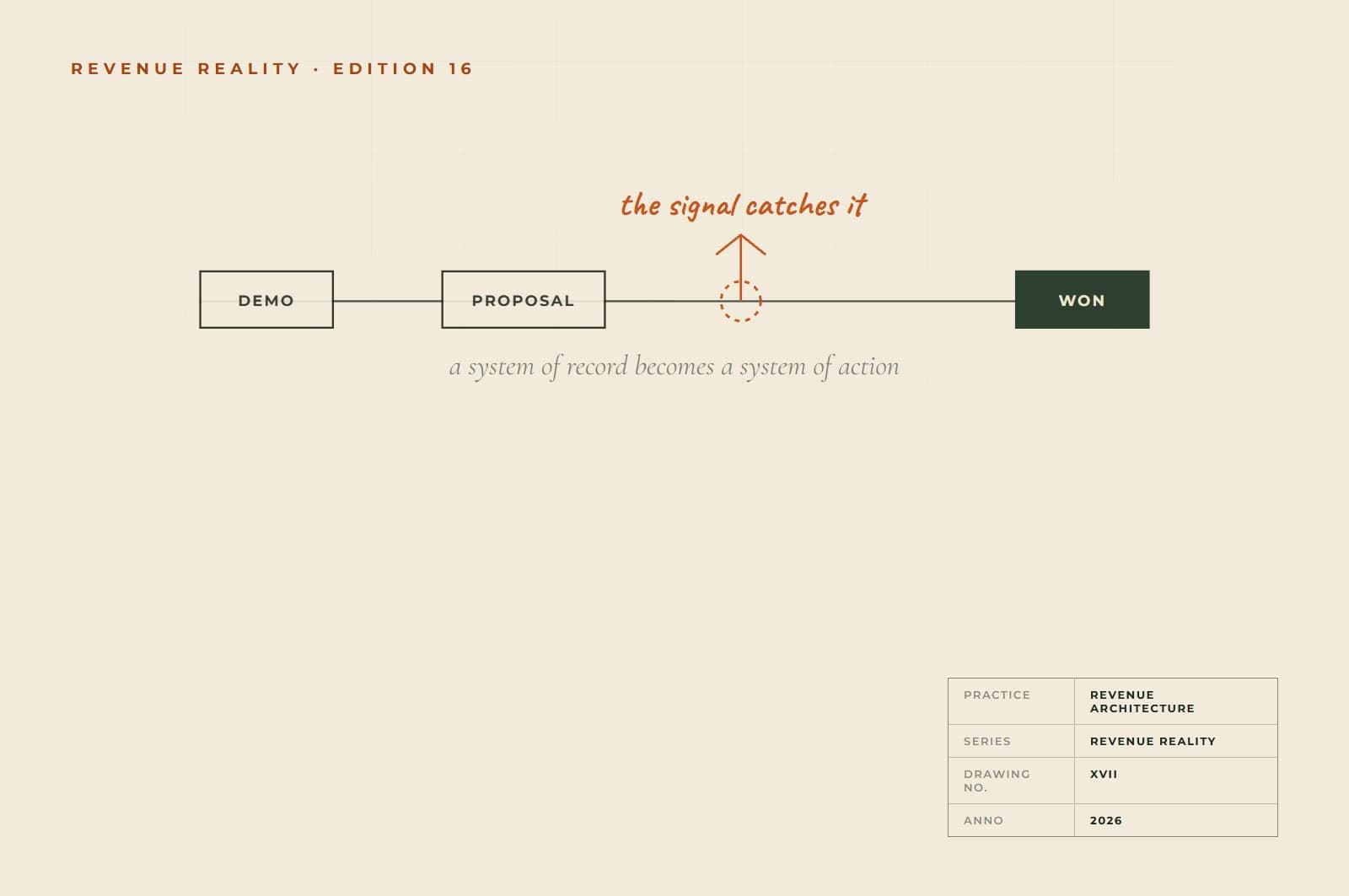
A CRM is a system of record. Its whole job is to remember. It logged the demo, logged the proposal, logged the “let me run this past the team,” logged the silence, and logged the close-lost. Perfect records of a deal dying. At no point was anything in that system built to do something about it. Follow-up is a different machine entirely. It is a system of action, and a system of action is judged by what it changes, not by what it stores.
When you bolt an automation layer onto a system of record and call it a follow-up solution, you have not changed the category of machine. You have just made the filing cabinet faster at filing. The reminders fire on your calendar. The reports tell you a deal went cold after it is already dead. The notes nobody reads pile up a little quicker. You did not have a technology problem. You had a system-of-action problem, and you tried to solve it by buying a better place to keep the paperwork.
Here is the test that cuts through it. Walk through every rule, sequence, and reminder running in your stack today and ask one question of each: does this change what happens to a deal that goes quiet, or does it only record that the deal went quiet? Be honest, because most of what you find will be record, not action. And a record, however intelligent, has never saved a single deal.
I watched a sales manager named Dave try to fix abandonment with automation. His team had no documented cadence, so every rep was improvising follow-up from memory and mood. Dave turned on the CRM’s “smart sequences” and pointed them at every open deal in the pipeline. The logic seemed sound. The follow-up was inconsistent, so make it consistent by letting the machine do it.
What he actually did was give the chaos a megaphone. Generic “just checking in” emails went out at scale, on a timer, with no reason to reply attached to any of them. Prospects who had gone quiet now went quiet faster, because the robotic touches confirmed exactly what they already suspected, that nobody on the other end was really paying attention. The automation did not repair the process. It industrialized the mistake and put it on a schedule.
This is the trap in one line. Intelligence layered on top of infrastructure compounds. Intelligence layered on top of chaos just amplifies the chaos. The teams that win with automation are the ones that built the manual system first and then taught the machine to run it. The order is not a preference. It is the whole thing.
The build is not a chatbot you bolt on. It is two layers of operational AI sitting on top of a process that already works by hand. It is the same logic that produced a documented 78% close rate on high-ticket B2B for me, and the same logic I have built into lead-to-revenue automation across client environments. Before either layer, there is a layer zero you do not get to skip: the documented cadence. Five touches, each carrying a real reason to reply rather than a reminder to “check in.” Without it, everything above has nothing to run, and you are back to Dave.
With the cadence written down, the first layer can finally do its job, and the second layer can do the thing that is genuinely new.
Each layer needs the one before it. Skip layer zero and you automate a void. The diagram is the whole argument: a documented process, then the machine that runs it, then the layer that watches the buyer.
Five touches, each with a date and a real reason to reply. Unglamorous, done by hand, proven to close before any tool touches it. This is the prerequisite, not the optional first step.
The cadence stops living in the rep’s memory and starts living in the system. Touch four gets queued, timed, and drafted with the right reason for that stage, waiting for the rep to personalize and send. The rep who quits at touch two is removed from the equation.
A sequence runs on your calendar. A signal runs on the buyer’s behavior. It watches for the moments a human managing forty deals will never catch by memory, and flags them while the deal is still warm enough to save.
The single most common failure point in follow-up is not strategy. It is the rep who goes silent at touch two because reaching out a third time feels like being a pest. He is not lazy. He has run out of reasons to call, and “just checking in” feels worse than saying nothing, so he says nothing and tells himself he is respecting the prospect’s space.
Layer one removes that decision from him. The system queues the next touch on the right day, drafted with the reason that fits that stage, the ROI number from discovery or a relevant result from a similar company, and hands it to the rep to personalize and approve. The deal no longer depends on whether someone felt like reaching out on a Thursday. That alone closes most of the gap between touch two and touch eight. But it is still running on a calendar. It does not know whether the buyer is hot, cold, or already signing with your competitor. That is what the second layer is for.
A sequence runs on your schedule. A signal runs on the buyer’s. The signal layer watches behavior and flags the moments that matter, the ones invisible to a human carrying forty open deals in their head.
Reply latency: the buyer used to answer in four hours, now it is three days, and the deal is cooling before the rep has felt a thing. The champion going dark: the one contact who opened every email quietly stops, which is usually the exact moment your deal lost its internal advocate. The committee shifting: a new name from the buyer’s domain starts opening your emails, telling you to change who you are selling to before the deal stalls waiting on an approver you have never spoken to. Silent intent: the proposal link opened five times this week with no reply, which is not a dead deal, that is someone selling your proposal internally right now, without you in the room, and they need ammunition you do not know they need. The revisit: a deal that went quiet two weeks ago just reopened your pricing page, and that window is open for about a day.
A reminder says “follow up Tuesday.” It fires whether the deal is alive or buried. A signal says “this went quiet six days ago and the buyer just reopened your proposal twice this morning, call them now.” One runs on your calendar. The other runs on theirs. Only one of them knows the deal is dying.
Take the same mid-market profile from last edition: a $4.5M company abandoning roughly $300K in post-demo deals every year. That is the leak. Real buying intent that walked in the door and drifted out the back while everyone was busy. Not all of it is recoverable, and pretending a tool recovers 100% is the same lie the software demo told you, so let me build the recoverable line in the open.
Say the signal layer surfaces only the deals going quiet while they are still warm, and that is half of the leak. That is $150K in still-live pipeline a year, flagged the week it starts cooling instead of discovered dead a quarter later. Re-engage those at the conservative 30% close rate the team already runs on qualified deals, and that is roughly $90K a year pulled back out of the graveyard, on a deal-by-deal basis nobody had to remember to chase. The signal layer costs a fraction of a single rep. The revenue it recovers is revenue you already paid to generate and then lost to a gap in attention. Run your own version of that math and the number is almost always bigger than the cost of building the layer.
Because the order is hard to sell yourself on. Documenting a five-touch cadence by hand is unglamorous. Buying a platform with AI in the name feels like progress. So the average team skips layer zero, buys the tool, points it at everything, and lands exactly where Dave did, with a faster version of the problem and a new line item on the budget.
The teams that win do the boring thing first. They write the sequence down. They prove it works manually. Then, and only then, they teach the machine to run it and add the signal layer on top, so the technology is amplifying a process that already produces results instead of amplifying a void. You cannot automate your way out of not having a process. You can only automate a process you already have.
Open your CRM or your marketing automation and look at every rule, sequence, and reminder running inside it. For each one, ask the single question from the top of this piece: does this change what happens to a deal that goes quiet, or does it only record that it went quiet? Most of what you find will be record, not action.
Then build one signal. Just one. Define it precisely: a deal past the demo stage with no buyer activity in the last ten days. Define the action it must trigger automatically: surface that deal to the rep today, with what changed and the next touch already drafted. If your current stack cannot do even that, you do not have a follow-up system. You have a graveyard with a search bar. Document the cadence, automate the cadence, then watch the behavior, in that order. A graveyard keeps perfect records. That has never saved a single deal.

Twelve years across three continents rebuilding the infrastructure B2B companies use to turn good people into predictable revenue. Now working from Sweden, with a smaller calendar and a tighter focus. Thanks for reading, new essays land here most weeks.
One essay a week on the work underneath B2B revenue. No pitch.
A 45-minute call. I tell you where the leaks are, whether or not we work together.
Let's talk