The buyer says yes in the room and means it. Then the contract goes out, the deal goes quiet, and a month later the rep writes "no decision" and moves on. These are not deals lost at the close. They die in the stretch between a verbal yes and a signed contract, the part almost nobody documents and nobody builds a path across. Here is why your best deals leak out after the yes, the four-step path that carries a yes to a signature, and the one habit that closes most of the gap.
 From the archive
The most fragile part of a deal is the part that feels safest. A buyer sits across from your rep, understands the offer, and says the words every rep waits to hear. Yes. Let's do it. Send it over. On the dashboard the deal turns green and the forecast counts it as good as won, and that is exactly the moment it is most exposed. The contract goes out and goes quiet. A week later it is in procurement. Two weeks later it is still reviewing internally. A month later the rep quietly drags it to closed-lost and writes no decision in the notes, as if the deal simply lost interest in itself. It did not lose interest. It was left alone in the one stretch of the sale nobody built, the gap between a verbal yes and a signature, and it fell in.
Most founders treat the yes as the end of the deal. It is the start of the most dangerous part. After a buyer commits, a whole invisible process has to happen before money moves: legal has to read it, procurement has to open a file, a security review appears, someone gets looped in who was never on the call. Every one of those steps is a place the deal can stall, and every one of them is missing from your pipeline, which still shows the opportunity sitting proudly in "verbal" with a green check beside it.
That green check is the trap. It tells you the deal is handled at the precise moment it needs the most work, so the rep mentally moves on to the next hunt and the buyer is left to navigate an internal process alone, with nobody on your side helping. A buyer who wanted to move gets stuck, and a stuck buyer does not send you an email explaining that they are stuck. They just go quiet, and quiet reads as rejection when it is usually paralysis.
This is why coaching the close harder does not fix it. The problem is not that your reps cannot ask for the business. They got the yes. The problem is that nothing was built to carry that yes from the room to a signature, so it evaporates in the gap, and the best deals in the pipeline are the ones with the most steps between yes and signed, which means they are the ones most exposed to it.
Take two reps on the same team, selling the same product at the same average deal size. Call them Colin and Nadia.
Colin is good in the room and gets the yes as often as anyone. The moment a buyer commits, he goes back to his desk, sends the contract by email that afternoon, writes "let me know if you have any questions," and waits. He believes the deal is done and he is proud of his verbal pipeline. Then the deals go quiet, one after another, and his week fills with chasing signatures over email and telling his manager they are in procurement. His yeses convert at a rate that would embarrass him if he ever ran the number.
Nadia almost never sends a contract into silence. On the call where the buyer says yes, before she hangs up, she does three things Colin never learned to do. She asks the buyer to describe exactly what happens next on their side to get a contract signed. She finds out who actually signs and what they need to see. And she books the next step, a specific date on both calendars, before the call ends. Her deals do not go quiet, because she never leaves a yes without a next date attached to it.
Same product, same buyers. Colin works harder than Nadia; he is chasing twenty stalled contracts while she is closing. The difference is not talent and it is not effort. Nadia runs a path from yes to signed, and Colin runs a hope.
A yes reaches a signature only if something carries it there. Four supports, and you build most of them before you ever ask for the commitment.
Not whether they will buy. How. "If this makes sense, walk me through what happens on your side to get something like this signed." A buyer who can describe their own process is close. One who cannot is telling you the yes is softer than it sounded. You are not asking permission. You are drawing the map.
Who actually signs, and what they need to see first: legal, procurement, a security review, a budget owner who was never on the call. A yes from someone who cannot sign is not a close. It is a warm introduction to the person who can, and your rep should be asking to meet them this week.
Never let a conversation end without the next step booked on both calendars. "Let's hold twenty minutes Thursday to take your ops lead through it." A deal with no next date is already stalling; you just cannot see it yet. This one habit closes more gaps than any script.
Before you leave the room, ask it out loud. "Realistically, what could get in the way between now and signing?" The honest answer surfaces the procurement freeze, the missing stakeholder, the budget that resets next quarter, while you are still there to handle it instead of a month later when it is a dead deal and a shrug.
The deals that die after the yes are not a rounding error. They are usually your best deals, the ones that got furthest, and they leak out in the quietest way there is, so the cost hides in the "no decision" column where nobody thinks to look for it.
Take an illustrative profile: a $7M company with five reps and an average deal size of $45,000. In a year the team brings roughly 90 deals to a verbal yes, a buyer in the room saying they want to move forward. That is real, earned pipeline. Now watch what happens with no documented path from yes to signed. Say 28% of those verbal yeses stall out and die before a contract is signed, not because the buyer changed their mind, but because nobody carried them across the gap.
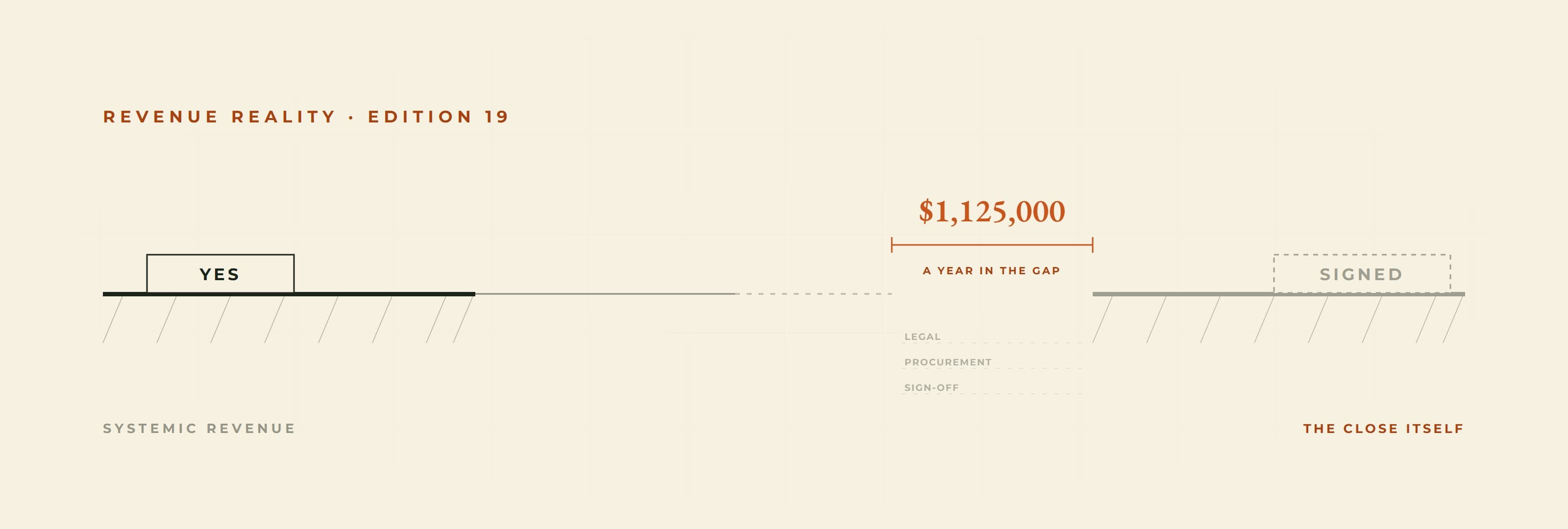
Twenty-eight percent of 90 deals is 25 deals. Twenty-five deals at $45,000 is $1,125,000 a year in business that said yes and never signed, on a $7M company. That is sixteen percent of the whole business walking out the door after it already agreed to stay, and it is the most winnable revenue you have, because every person in it already told you yes.
When a deal dies after the yes, the story the team tells is about the buyer: they went cold, procurement was slow, the timing slipped. Sometimes that is true. Far more often the deal died because there was no defined sequence between the verbal commitment and the signature, so the buyer was handed a contract and left to close themselves, and most buyers, facing an internal process and a dozen other priorities, quietly do nothing.
The fix is not a better closing line or more urgency on the follow-up. It is the same thing that fixes every other leak in the revenue system: a documented path, built once, that every rep runs the same way. The Close Path is that infrastructure for the finish of the deal. Build it before the yes, and the yes has somewhere to go the moment you get it.
Pull every deal marked verbal, committed, negotiation, or closing that has sat there longer than fourteen days. For each one, check a single thing: is there a specific next step, with a date, on someone's calendar? Not "following up soon." Not "checking in next week." A booked time. Where there is not one, that is your answer, and it is more common than you expect.
Count the deals with no next date and add up their value. That number is your closing leak, and unlike most leaks it is sitting in your warmest pipeline, because every person in it already said yes. You are not trying to convince them. You are trying to reach them before the silence does. Book the next step on every one this week, then build the path so the next quarter of yeses never sits in an inbox waiting to die.

Twelve years across three continents rebuilding the infrastructure B2B companies use to turn good people into predictable revenue. Now working from Sweden, with a smaller calendar and a tighter focus. Thanks for reading, new essays land here most weeks.
One essay a week on the work underneath B2B revenue. No pitch.
A 45-minute call. I tell you where the leaks are, whether or not we work together.
Let's talk