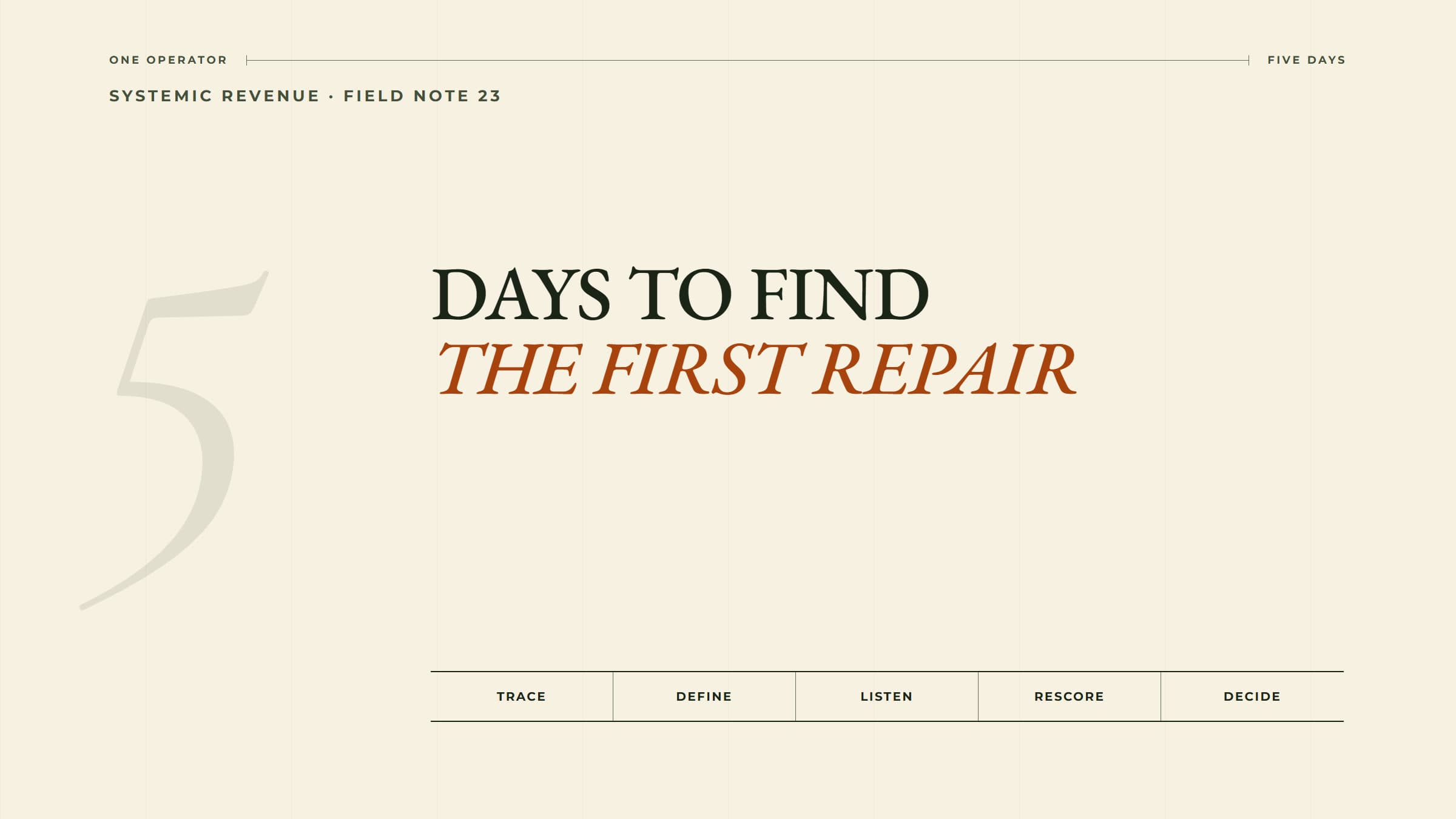
More lead volume can give an established company more opportunities. It can also send more people into a sales process that nobody can explain. I spend the first five days finding where the current route breaks before prescribing more traffic, another tool or a new script.
“Find the truth before you add volume.”
From the archive
An established company can have active campaigns, regular inquiries, experienced sellers and a pipeline that still fails to produce reliable revenue. The usual response is to add something: more leads, another seller, a new script, a stricter CRM rule or an AI tool that promises to recover every missed follow-up. Any of those may help. They may also send more work into the same leak.
When I step in as a Fractional Sales Operator, I spend the first five days establishing what happens in the revenue system the company already has. The question is where an inquiry becomes a useful conversation, what turns that conversation into an opportunity and what evidence allows the team to believe revenue will follow.
Until those points are clear, asking for more leads is a guess.
A lead problem and a conversion problem can look similar from the boardroom. The sales number is behind plan. The pipeline feels thin. Sellers say they need more conversations. Marketing is asked to increase volume.
The first question should be simpler: what happens to the demand already entering the company?
Some businesses genuinely need more of it. There are too few suitable inquiries for the sales team to reach the target. That is a demand problem, and it deserves a demand solution.
Other businesses already create enough interest to expose a different problem. Responses arrive too slowly. Leads reach the wrong person. Sales conversations fail to establish the decision. Proposals are sent without a reason to believe the work will be approved. Opportunities sit open because nobody wants to admit that the last meaningful conversation happened six weeks ago.
More volume will make those failures busier.
This is why I do not accept "we need more leads" as the diagnosis. It is a reasonable concern and a possible answer. I still need to trace what happens now.
The first conversation about the engagement needs to establish what I can inspect. I need enough access to see the route from inquiry to revenue. That normally includes a selection of active, won and lost opportunities, the relevant CRM records, recent sales conversations and the people who own the handoffs.
I am not asking the company to produce a perfect data room before work begins. Missing information is part of the diagnosis. If nobody can connect an inquiry to the resulting opportunity, that is something the revenue system needs to address.
Access is not there so I can produce a report about everything the company has done wrong. It lets me compare the different accounts of the same deal.
What did the prospective client ask for? What did the seller believe the problem was? What did the CRM record? Why did the opportunity move? What does the company expect to happen next?
Those questions give us a place to begin without pretending that the answer is already known.
I start with individual opportunities because averages can hide the mechanism. A dashboard may show that proposals convert poorly. That still leaves several different explanations.
Sellers may be sending proposals before the decision process is understood. The scope may change between the call and the document. Pricing may be presented to somebody who cannot approve it. The company may even count a proposal as active when the prospective client never asked for one.
The percentage tells me where to look. The opportunity tells me what happened.
For each selected deal, I follow the route from the original inquiry to the latest action. I look at response time, ownership, the first conversation, the stated problem, the desired result, qualification, stage movement, the proposal and the next decision.
The exact route differs by company. The discipline does not. Every step should have an owner, a reason and enough evidence to choose what happens next.
When those are missing, people compensate. A good seller remembers to chase a handoff. A manager interprets a vague note. A founder joins a late call to rescue a deal that was weak from the beginning. That effort can keep revenue moving for a long time. It also makes the system look healthier than it is.
Use one live opportunity. Compare the work with the record.
What did the prospective client ask for, and who owned the first response?
What problem and desired change did the seller understand?
What fact justified moving the opportunity into its current stage?
What has been agreed, what remains uncertain and who owns the next action?
Which commercial event will turn the opportunity into money the company has actually earned?
The most useful discovery is often a disagreement between two parts of the company.
Marketing believes a lead is ready because the person requested a particular resource. Sales believes the same lead is weak because there is no visible buying project. Delivery believes the offer includes a level of support that the seller did not mention. Finance waits for an approval the sales process treats as complete.
None of these people have to be careless for the handoff to fail. They may be following different definitions.
I look for the first point where the accounts stop matching.
If the lead source promises one problem and the first call investigates another, the seller begins with avoidable confusion. If qualification is based on company size while the offer depends on a particular operating condition, suitable-looking prospects will keep entering the wrong conversation. If a proposal stage only proves that a PDF was sent, the forecast carries confidence the buyer never provided.
The first disagreement gives us a bounded repair. We do not need to redesign the whole revenue operation to clarify what makes an inquiry ready for a conversation or what evidence should exist before a proposal is counted.
Sales calls matter because this is where the formal system meets a real person. I do not begin by grading confidence, energy or adherence to a script. I listen for whether the seller had enough support to make good decisions.
Did they know what they needed to understand before recommending the work? Could they explain the offer in terms the prospective client recognized? Did they establish who would make the decision? Was the next step agreed during the call, or added to the CRM afterwards?
When the call becomes difficult, I ask what created the difficulty. Sometimes the seller lacks a useful question. Sometimes the process tells them to present before the problem is clear. Sometimes the offer is difficult to explain because the company has not settled the scope. Sometimes the prospective client simply does not want to continue.
Those situations should not receive the same coaching. "Be more confident" gives the seller little to work with. "Confirm who else needs to approve the work before you offer a start date" describes a decision they can practice.
Coaching should help somebody perform the next piece of work, not describe the personality the manager wishes they had.
Before changing the words, find the decision they are supposed to support.
Most CRM stages sound more precise than they are: discovery complete, qualified opportunity, proposal sent, negotiation, commit. The labels imply that the company knows what has happened. Ask three sellers what evidence belongs in one of those stages and you may hear three different answers.
Each stage needs to answer two questions. What decision has already been made? What decision must happen next?
The evidence should be visible enough for another person to understand why the deal is there. It does not need to become a bureaucratic checklist. A small number of meaningful conditions is more useful than twenty fields people complete after the fact.
Consider "proposal sent." The seller emailing a document is an activity. A stronger stage may require that the prospective client has asked for the proposal, understands the scope and has explained how the decision will be made.
That changes the forecast. It also changes the seller's work before the proposal. The company can now coach the missing decision instead of chasing the document.
Once the evidence is clear, I apply it to live opportunities with the people who own them. Some deals will remain where they are. Some will move backwards. Others will close because there is no active decision left to support.
This should not become a performance theatre where the operator proves that everybody else's forecast was wrong. We need a shared account of what is known.
If sellers are punished whenever a deal moves backwards, they learn to defend the old stage. If they are allowed to show uncertainty and ask for help, the pipeline becomes a management tool.
The rescore also reveals patterns. Several opportunities may need the same decision maker. Several sellers may struggle to connect the offer to the problem. A particular lead source may produce interest without a buying reason. One handoff may rely on a manager who is already overloaded.
Now leadership can decide where one change would support several deals. An honest pipeline may be smaller. It is more useful because the company can see the work required to move it.
Automation is good at repeating an instruction. It cannot settle an instruction the company has never agreed.
If a lead has no clear owner, an automated reminder creates another notification around the same ambiguity. If "qualified" means something different to each seller, an AI summary can record the disagreement faster without resolving it. If a follow-up was never agreed with the prospective client, a perfect sequence can become an efficient way to continue a conversation they have already left.
I look at ownership before adding machinery. Who responds to the inquiry? Who decides whether it belongs in sales? Who owns the next action after the call? Who can close an opportunity that no longer has a route forward?
Once those decisions are clear, automation can remove useful administrative work. It can route, remind, summarize and expose exceptions. The tool now supports a rule the company understands. Without that rule, the tool makes the confusion move faster.
There are calls where the language needs work. The opening may sound like an interrogation because the seller has never explained the purpose of the questions. The offer may be buried under technical detail. The price may be followed by five nervous concessions before the prospective client has answered.
I will repair those moments. The difference is that the new words have a job.
An opening should establish what the conversation is for. A discovery question should help the seller understand a decision that matters. A summary should let the prospective client correct the seller's understanding. A close should make the next step clear without forcing an answer.
The script becomes a support for judgment rather than a performance the seller must complete. This makes the language easier to coach too. The manager can listen for whether the seller achieved the purpose, not whether every sentence matched the document.
The first five days should leave behind something the next seller can learn.
Start with the route the company now understands. Show what must be known before an opportunity advances. Use real calls, but stop at the decisions instead of asking the new seller to copy the voice.
What did the experienced seller know at that point? What remained uncertain? Why did they ask that question? What evidence allowed them to continue?
This turns experience into instruction. The new seller can use different words and still make the same sound decision. The manager can coach the reasoning. The CRM can reinforce it. The company is no longer hoping that exposure to a strong performer will somehow transfer judgment by imitation.
Onboarding becomes part of the operating system rather than a collection of material somebody prepared before the new hire arrived.
The end of the first week should produce a working position, not a final diagnosis of everything that could be improved. Friday should leave five practical outputs.
First, a map of the current route from inquiry to revenue, including the handoffs that actually exist.
Second, an evidence-based view of a selected part of the active pipeline.
Third, the first point where the buyer's reality, the seller's understanding and the company record stop matching.
Fourth, one bounded repair with an owner.
Fifth, a short operating rhythm for the next week: the deals that need a decision, the call the team will review, the handoff leadership will fix and the evidence the manager will coach.
There may be more work afterwards. Usually there is. The point is that the company now knows why the next piece of work comes first.
I am most useful to established companies that already have an offer, active lead flow and people doing sales work.
The symptoms can vary. Close rates have stopped improving. Sales cycles stretch without a clear reason. Reps work hard but use different definitions. The founder keeps entering late-stage calls. Marketing produces demand that sales does not convert. The forecast changes according to who tells the story.
Those are situations where an outside operator can establish the current truth and help the team run the repair.
If the company has no demand, no settled offer or no capacity to deliver, another problem may need to come first. I will say that. The engagement should solve the problem the company has, not provide a reason to use every service I can offer.
I currently have room to step into one or two established companies as a hands-on Revenue Architect or Fractional Sales Operator. The work can include pipeline diagnosis, call review, qualification and stage design, sales management, script repair or direct support on live opportunities.
If leads are arriving and revenue is getting stuck somewhere before the money does, send me a message. Tell me what you sell, where the pipeline appears to slow down and what you have already tried.
I will tell you whether I believe I can help and what I would look at first.

Twelve years across three continents rebuilding the infrastructure B2B companies use to turn good people into predictable revenue. Now working from Sweden, with a smaller calendar and a tighter focus. Thanks for reading, new essays land here most weeks.
One essay a week on the work underneath B2B revenue. No pitch.
A 45-minute call. I tell you where the leaks are, whether or not we work together.
Let's talk